Thursday, November 9, 2017

November Update and Look Ahead...

      Now that the prime golf season is behind us and cool temperatures are approaching, it is time for my staff and I to start focusing winter projects and important agronomic practices that will help keep Piedmont great.


Tee Aerification and Bunker Elimination:  I know I touched on these points the other week but we will be continuing with our tee aerification over the next couple weeks.  Again it important we aerify to not only relieve compaction and improve drainage but it opens up channels for oxygen, nutrients, and water to reach the root system.  Aerification is arguable the most important agronomic practice we do as superintendents and doing it this time of year is almost like hitting the “reset button.”  We will be topdressing and fertilizing them heavy along with the aerification and come next spring when growing conditions improve we should have great tees for the upcoming season.  Along with the core aerification, we will be using the plugs to fill in a select few bunkers (#8, #9, and #14).


#4 Green:  #4 green is now being mown at the same height as the rest of the greens on the course, which is .12 hundredths of an inch.  It is still a new green but I have been happy with how it held up all year to the stresses that come with growing grass outside Washington D.C.  The plan is to continue treating it like a new green through the winter but hopefully by the time spring comes around next year it will be mature enough that I can manage it the same as the other greens on the course.


Tree Work/Removal:  A big task my staff and I are going to focus on this winter is improving air flow around the course.  Whether that is clearing underbrush in heavily wooded areas, taking limbs off of trees, or taking trees down entirely one thing I noticed in my first year that there are a few areas on greens that struggle or stay wet entirely too long.  A major reason for that is poor air flow.  Obviously the houses have something to do with that as well but with areas like to the left of #17 green and to the right of #6 green and even to the right of #16 green we can go in there and clear a lot of material out that will not only improve air flow but to reduce shade and improve sunlight on areas that may stay overly saturated. 


Frost Delays:  It’s that time of year again, though it has been a mild fall so far FROST DELAYS are right around the corner.  Frost is essentially frozen dew that forms ice crystals on the outside of the plant.  Obviously the turf is resilient to foot and cart traffic during regular weather conditions but when the plant has frost on it, it becomes brittle and fragile.  And when pressure is applied to the turf plant in this state the plant tissue will be punctured by the ice crystals and plant cells will rupture.  Damage caused by traffic won’t be visible right away, it will take several days before you start to see the signs of frost damage.  On top of that, frost damage caused by cart or foot traffic coupled with dormant turf and poor growing conditions means we will be looking footprints and cart tracks until the spring.  So please, be patient when we say there is a frost delay it is better to play it safe vs. stare of photos like below all winter long.


Thursday, April 13, 2017

A little brush up before we get into full swing...

With spring rapidly approaching I wanted to take a few moments to brush up on some etiquette topics that not only positively impact the golf course but also your experience and the experience of your guests and other members.

Repair Your Ball Marks and One Other:

This is sometime simple that everyone should do as they play.  Take a prolonged object with a pointed edge, a proper ball mark repair tool is best but a tee will work just fine as well.  As displayed below you want to insert the tool into the turf at the edge of the ball mark and push towards or twist towards the center of the indentation.  You want to do this in three or four places around the ball mark until it enclosed and then tap down with you foot or putter.  You NEVER want to repair a ball mark by lifting up from the center, that will expose more soil to the surface and tear the roots which will extend the heeling time of that ball mark.

Remember you are doing this to improve the putting surface for yourself, your guest, and other members so when you finish repairing your ball mark, repair one other before leaving the green.


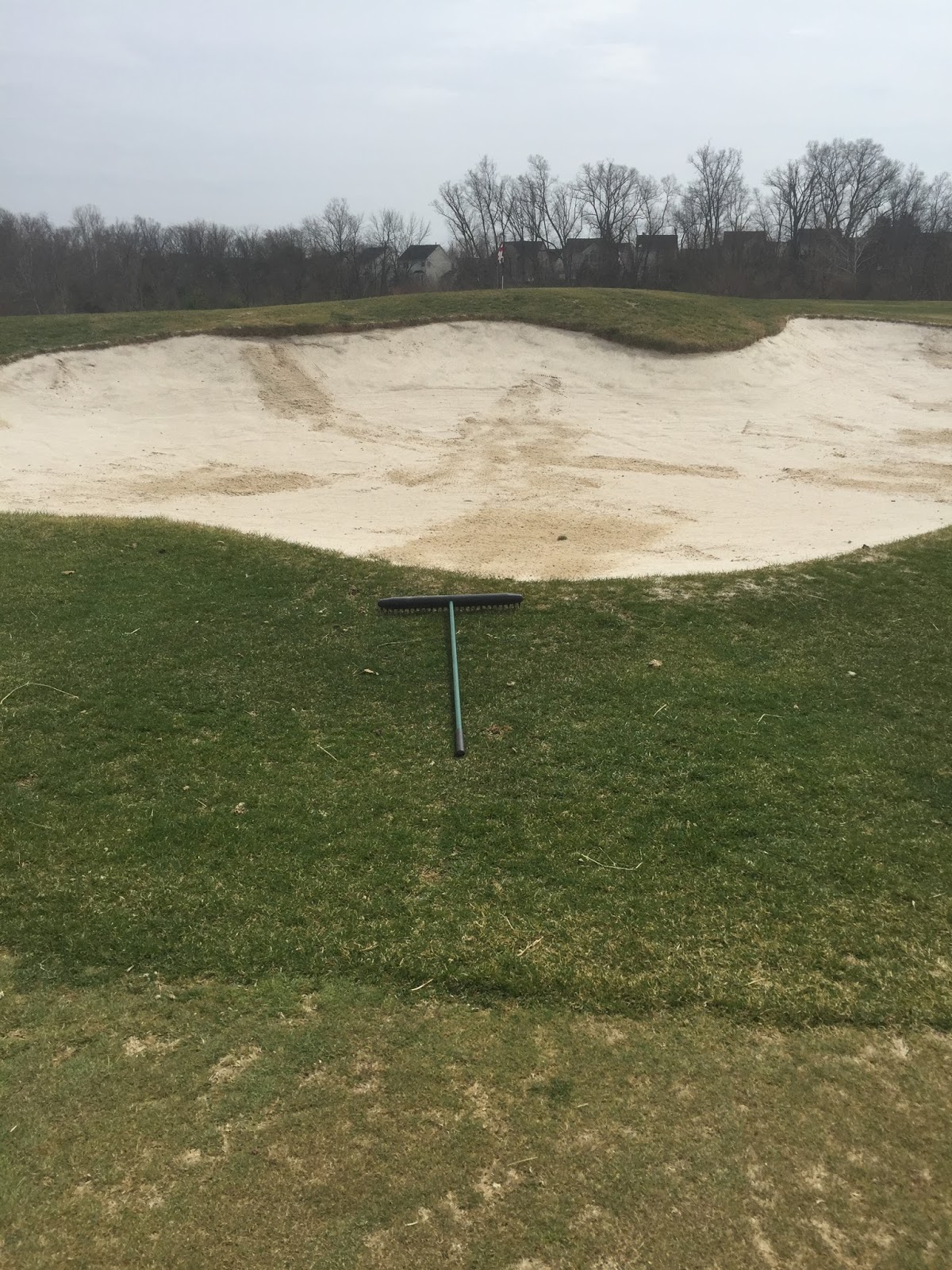
Bunker Etiquette:  First things first, when it comes to bunker etiquette, always enter the bunker on the low side.  Major disruption and damage is caused by people entering the bunker on the high, step sides.  Also, when entering the bunker take the rake in with you.  Remember to use two hands and smooth out any disruptions caused by your feet or the ball first with the back side of the rake and then  rake out the disrupted area always pushing the sand way.  Lines and indentations are made when the sand is raked and pulled back towards you.  Finally, when raking out the bunker you want to exit the bunker the same way you entered minimizing the amount of area you disturb.

But you are not done just yet when you exit the bunker.  Rake placement is a key part to bunker etiquette.  You want to make sure that the rake is always placed on the outer side of the bunker so that it will have the least impact on play with the handle laying parallel with the line of the incoming show.  Also around greens, make sure to never place the rake between the bunker and the green

Proper Bunker Rake Placement for #1 Greenside Bunker

Incorrect Bunker Rake Placement for #1 Greenside Bunker


How To Rake a Bunker...


Divot Repair:  Whenever someone asks me "What is the right way to fill a divot?", I always tell them "Less is More."  When adding sand to a divot, you are merely bridging the gap for the turf to grow over.  Giving it a medium to grow through.  When you mound up the sand it does nothing but damage our equipment.  So again, I always tell people "Less is More" when it comes to filling divots.


Cart Traffic:  We, as a maintenance staff, are going to need a lot of help with this one.  The general rule for carts is once you enter the fairway from the cartpath you stay in the fairway until you exit to return to the cartpath.  Even if your ball is in the rough we ask that you  pull up to the edge of the fairway, park, and walk out to your ball.  Parking in the rough and driving in circles searching for golf balls or just going to point A to point B is very bad for the rough.  I know that seems counter intuitive since the rough turf is much longer than the fairway turf and you feel that it should be much hardier and be able to sustain the extra stress.  Unfortunately, that just is not the case and once the rough starts going down hill due to stress (Which summer patch is a turf disease brought on by stress) it is hard to get it come back especially during the hot, stressful summer months.

Each hole will have two posts indicating where to exit the cartpath to drive to the fairway and where to head back to the cartpath (Par 3's will not have posts since they are all CPO).  The first post on each hole will be along the cartpath and the second post will approximately 20 yards short of the green to indicate where to exit the fairway and go back to the cartpath.  These posts will me frequently to help disperse cart traffic evenly.


If you ball is in the rough near the edge of the fairway, please park your cart in the fairway and not in the rough

Another example of where not to park.  Pull your cart up to edge of the fairway, while staying in the fairway, park and walk out to you ball.

Thursday, February 16, 2017

Why we have frost delays...

As a golfer, there are few things worse than a frost delay, maybe going CPO (Cartpath Only).  But as a Superintendent I promise there is a reason...

Frost is essentially frozen dew that crystallizes on the grass.  If you didn't already know, grass is comprised of 90% water much like the human body.  When explaining to people why we have frost delays I typically relate it the human body.

Since the grass is comprised of so much water it also freezes along with the dew on the surface.  This makes the individual blades of grass very brittle (especially the low mow'n areas like the greens).  Walking or driving on the turf while it is frozen causes the cell walls inside the plant rupture making it impossible for the plant to function properly much like breaking your arm or even your back.  But unlike the human body the turf cannot repair itself, you will have to wait till better growing conditions and new grass germinates.  Which it happens early on in the cooler months you will be looking at damaged and affected playing surfaces for months

And why we are so careful...

The average golfer takes 60 steps on each green.  Multiple that by 18 and then lets say its a decent winter day and we have 65 rounds.  That comes out to 70,200 steps just on the greens.  That is a lot of pressure to put on turf that is cut down as low as an eighth of an inch and is made up of 90% water.

And it is very difficult to judge when it will lift.  Have to consider shaded areas, low areas, and even sometimes it appears to be fine but the frost likes to linger at the base of the plant.   We do our best to judge when it maybe good to go but it is something to err on the side of caution...

We do it for the golfer, we promise...


Thursday, August 11, 2016

Is it Fall Yet!?

After a very hot July we are hoping August temperatures stay cooler moving into September. July's average high temperature was 90 degrees which is two degrees warmer then the average of 88. Most areas of the golf course held up well through the heat and humidity. We have only noticed a little bit of Summer Patch in the roughs. The intermediates where we saw it the most last year are holding up well so far. The additional preventative application for Summer Patch has helped significantly this year.

Lack of air movement keeps the top section of the greens mix saturated which leads to shorter roots and unhealthy turf. The 6th and 12th green are two examples of where the air is stagnant during the summer months. You might have noticed a few things we have been doing to help reduce the moisture and create more airflow. A week ago we punched some small holes in these greens as well as the other areas weakening from stress, this is to help more oxygen get down to the roots. We have also been setting up a pull behind blower behind the green to help move air across the surface. The blower can be loud but it will help the plant recover from the stress heading into the fall. We  have also done a little bit of spot seeding on some collars to help the Bentgrass fill in. This fall and winter we will be doing some more brush and small tree clearing around these greens to help going forward.

The 12th green where some of the turf has weakened 

Blower behind the 12th green to create air movement

As we move into the fall we will be spraying out weeds and undesired grasses throughout the golf course. You will notice these grasses/weeds turning yellow then eventually dying. We will also be applying grip paint onto the cart bridges on September 6th when we are closed for aerification.

Thank you in advance for filling your divots and fixing your ball marks.  If you have any questions at all please feel free to email me at Patrick.McNamara@clubcorp.com. 

Thursday, July 14, 2016

Annual Bluegrass Weevil Damage

This morning we noticed some Annual Bluegrass Weevil damage on the collar of the 6th green. They chew on the edges of leaf blades or stems of the plant close to the crown. They create a look similar to heat stress or ware areas from mowers and or rollers. We sprayed for them this morning, we should see the turf bounce back over the next few weeks. This was the only area that we saw bad damage from them.
Damage on the left collar on #6 green. 

Adult Annual Bluegrass weevil and Pupa found in the collar on #6. 

Wednesday, July 13, 2016

Things to expect over the next few months.


With the hottest two months of the year approaching we would like to remind everyone of a few things you might notice on the golf course. When we get into a period where we haven’t had any rain for over two weeks you will notice some browning on parts of fairways and roughs. This is due to shale close to the surface which heats up the roots from underneath. These areas get extra attention and receive more water to make sure we don’t lose any turf. The high humidity during the summer months makes some areas on tees become puffy in the thatch layer. These areas are usually seen on tee boxes that aren’t used as much (i.e. Gold and Green tee boxes). The tee boxes that are used more receive more foot traffic which helps firm them up and not get puffy. Summer patch in the intermediate cut and roughs can show up toward the end of July. We have added a spray which was talked about previously to help reduce the severity of it. When we talk about summer stress these are the things we are referring to.
Area on #1 forward tee that scalped and heated up due to excess thatch  

#7 fairway is a prime example of where we don't have much soil and the roots heat up from underneath. 

We have also applied some traction paint to the walk bridges. If  this paint shows to be durable it will help up decide if this is the best product to apply to the center of the cart bridges for walkers.

Thank you in advance for understanding how big of an impact the weather plays a role in what we decide to do every day on the golf course. When we get consistent temperatures in the 90’s we may reduce the amount of mowing and rolling we are doing weekly to help reduce the stress on the greens.

Last but certainly not least please remember to help maintain your golf course by fixing ball marks, filling divots and raking bunkers! Have a great summer from the Piedmont Maintenance Department!

Thursday, May 12, 2016

Sixteen Days of Rain and Counting

Well we were in need of rain three weeks ago, now we can all agree we have had enough after 16 straight days of  precipitation. This many days without sunshine and having wet conditions has some affect on the turf.

The greens on holes 1,2 and 16 have small sections that are high traffic areas from walking on and off the green. These particular areas wear down easier in wet conditions.  We have used a tool to put some small holes in these areas to help get the water off the surface and help them dry out. We have added some seed to a couple of the worst areas. Once we get some sunshine and dry weather these areas will start to recover. Please do your best to try to avoid these areas when walking on and off the greens so they can recover faster.  You will noticed we also added a rope line to help keep everyone from walking in the same spot.


Left side of  #1 green 

Left side of # 2 green

Red Thread

In the roughs you might notice some grass that is red and thin looking. This is called Red Thread Disease. This will very rarely actually kill the grass, it just turns red and the affected area will get thin. This disease becomes active when we have a lot of humidity in the air for multiple days in a row. This is not something to be concerned about on the golf course, once we get some sunshine and dry days the grass will grow out of the disease. 

  
Red Thread on #9

PoaCure

So far we are seeing great results from the Spring trial of PoaCure. The 3rd application was made yesterday and the last application will be made in two weeks. The wet weather has actually accelerated the root uptake of the chemical into the Poa plant, which can kill the Poa Annua quicker. We will be fertilizing the trial area to help push the Bentgrass to over take the Poa voids and any seeding will be done during the June aerification. Thank you for your patience during this trial.   
PoaCure on #4, The bentgrass is green and the Poa is Yellowish brown.


Overall the golf course has recovered nicely from aerification. We still have some projects that will continue through May. For example we will be doing another bunker audit for sand depths and weeds in all bunkers The rains can move the sand off slopes and produces weeds on edges of bunkers. Hopefully next week will be drier so we can get a good dry cut on all surfaces. Thank you for remembering to fix your ballmarks and divots.